
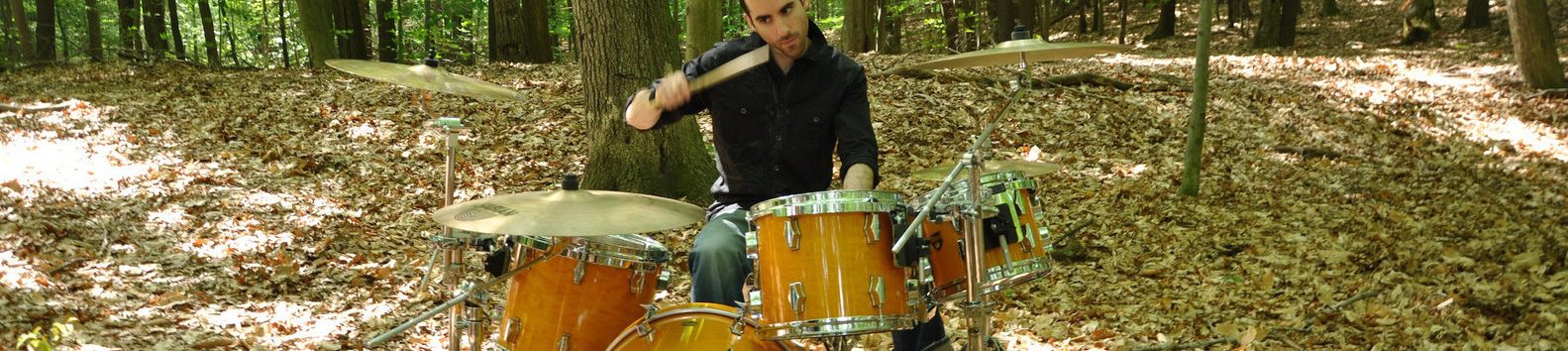
In the above video I’m demonstrating a moeller exercise as written in the PDF. I like to call this traditional Moeller because of the big exaggerated movements at the slow tempo as well as the obvious forearm rotation.
In Sanford Moeller’s book “The Moeller Book” he describes just three strokes–down stroke, up stroke, and the single stroke–which we now call taps. Notice in the video at the very slow tempo the down strokes and up strokes are almost identical movements. Both are similar wavelike movements. Actually, the only difference between the two is the stick makes contact with the head during the up stroke; the downstroke gets close to the head but does not make contact.
I believe forearm rotation is key to traditional Moeller. I initially learned the full stroke without the forearm rotation. Around a decade later, when I studied with Chapin he pointed out that what I was doing wasn’t actually what Sanford Moeller taught. Rather it was a modified Moeller because I was using all wrist pronation and no forearm rotation. My wrists were doing most of the work instead of off-loading some of that work to a natural forearm rotation.
In the video the forearm rotation is easy to see at the slow tempo. It’s still there at the faster tempo but it’s just a more subtle movement. At fast tempos I usually don’t rotate my forearm and doing so requires me to really concentrate on the subtleties of my movements.
I also like to point out to people that this traditional style of Moeller is more relevant when you are playing traditional grip with a slanted snare surface–just like the old school military drummers. However, I still like to teach the Moeller movements with and without the forearm rotation to see which one the student is more comfortable with. Even for a matched player like myself, there are still many applications for the forearm rotation on the drum set. I’ll do a blog lesson on that hopefully in the near future.
I’ve been focusing on stick control with a few dedicated students so I thought why not make a video of some of the exercises? The video above shows two exercises. The first version of the exercise is a Moeller Hybrid because it uses techniques popularized by both Sanford (Gus) Moeller and George Lawrence Stone. The quarter notes are played using a variation of Moeller’s little finger grip. Just grip the stick toward the butt end with your pinky and form a loose fist with your remaining fingers.
Little Finger Grip
The purpose of this practice grip is to make it easier to feel the stick’s rebound as a jolt of electricity–not for playing the kit. I’ve been using this grip with full strokes to help students internalize their stick-rebound timing with forearm rotation. The rest of the exercise is played with a middle finger fulcrum grip that utilizes the pull out/whip without forearm rotation, which is why I call it a Moeller-Hybrid.
Middle Finger Fulcrum Grip
The second version is the same exercise but uses open/close technique (also known as push/pull). This technique was popularized by Billy Gladstone and more recently by Gordy Knudtson. Both exercises were played in matched grip with slightly exaggerated movements.
I am now accepting drum students for my new teaching space in Santa Ana, CA. The room is equipped with two full size professional drum sets, sound system and other teaching and learning goodies. Check out my lessons page for more info!
Playing drums is a physical challenge. The longer you play the greater the probability of developing a repetitive-strain related condition (RSI) or carpel tunnel syndrome (CTS) symptoms. These types of injuries are also called “overuse injuries” because they are the result of repetitive use and stress to the soft tissues of the body (muscles, tendons, and joints) without allowing proper time for healing. Sometimes an acute injury (injury related to a single event) can lead to a RSI condition. These conditions are really stressful because they linger on and can wreck havoc on us mentally. Since I’ve been dealing with these conditions for the past decade , I’d like to share some insights on what I’ve learned over the years.
1. Rest and Ice
RICE is an acronym for Rest, Ice, Compression, and Elevation. It’s the go-to first aid treatment for acute-soft tissue injuries. However, for overuse injuries rest and ice have helped me the most. If your resting your body enough than low impact activities such as swimming, walking, stretching, and even a short drum playing session will help. Ice (not heat) will help reduce the inflammation. For acute injuries, I add compression and elevation to the healing mix.
2. Technique
If you haven’t yet studied the Moeller method, now would be a good time to get into it. Although the Moeller technique won’t cure an overuse issue on the spot, it’s great for preventing these types of injuries, as well as your overall playing. I recommend Jim Chapin’s DVD entitled “Speed, Power, Control, Endurance.” I also recommend switching to a thicker stick which can make it easier to play utilizing a looser grip. 5As would be the thinnest I recommend.
3. Body Movement
I’ve started taking Alexander Technique classes in 2008 and I have to admit I really wish I started this technique when I was much younger. It’s great for any musician but I think it’s especially helpful for us drummers. Basically, this movement technique helps you become truly aware of your whole body and your tension areas. You can practice this technique while doing Moeller exercises. You can also practice this technique while doing just about anything. Private lessons with a good teacher is the best way to get started; however group classes, which can be more affordable are becoming popular for beginners.
Check out this video that features my instructor Mark Josefsberg:
4. Sleep
Many of us don’t get enough sleep. Unfortunately, lack of sleep is one of the major causes for repetitive injuries. Sleep helps the body repair tissues and rejuvenates the nervous system. Get to know your body and how much sleep it needs for you to have a full tank of gas before you start your day. The quality of your sleep is just as important. I’d rather get six hours of uninterrupted sleep than nine hours of turbulence. I found that good quality sleep is vital to managing any stress related condition.
5. Yoga
Yoga is great for increasing flexibility and releasing tension. I started taking yoga shortly after I was diagnosed with CTS. After two months, the tingling and numbness in my hands disappeared. If you haven’t taken a class, I recommend starting with a beginner Hatha or Vinyasa class. If you go to a class while having a CTS flare up, it’s best to modify some of the poses. Make sure to tell the instructor before the class starts what you are dealing with. On the other hand, if your not having a flare up then you should focus on strengthening the muscles around the injured area. Check out this yoga journal article about healing CTS.
6. Building Muscular Support
Once you’ve allowed yourself enough rest and low impact activities, it’s time to bring on the weights. It’s important to build some muscle mass surrounding the chronically injured area. This helps circulation in the weakened area. The stronger muscles thus help support the whole area. However, it’s a balance and the trick is not to overdo it. Ease in to it. Start with light weights, high reps, and focus on your form and movement.
7. Stretching Before you Play
It’s common sense to always stretch before doing any strenuous activity. However, sometimes we forget (I admit it) –once we see drums our primal instincts take over and we are too excited to do anything except make noise:). The good news is we don’t have to stretch immediately before playing to gain the benefits. I like to stretch at least an hour before a gig and then focus on keeping loose and warm right up to show time. I do a combination of yoga and hand stretches –getting into the stretch details would entail a separate post. For now, check out this samba drummer’s stretches if you need a few ideas: http://www.puppetista.org/drums/stretch.html
8. Joint Support Supplements
There are a lot of supplements on the market that claim to work wonders. I have taken glucosamine along with chondroitin during stress flare ups and more recently for preventive measures. I can’t say for sure if these supplements work but I am certain that I’ve never had any side effects. I also think they might work well as a placebo effect and if they give you confidence to work through a mentally challenging condition, then more power to them. The main drawback is the money. The better brands can be expensive and most manufactures say you need to take the supplements for at least two months before organic change can occur.
9. Diet (Treat Your Body Like a Temple)
Since both CTS and RSI symptoms are caused by inflammation it makes sense to eat foods that can give you anti-inflammatory benefits. Basically, you want to stay away from saturated fats and refined sugars. I’ve slowly added more raw foods into my diet over the years and it’s made a big difference. Some herbs may also have an anti-inflammatory effect. Ginger, basil, and willow bark have worked wonders for me.
Dr. Linda Mundorff recommends reducing the consumption of alkaloid-containing fruits, vegetables, and spices (many in the nightshade family of plants) that may trigger inflammatory-related joint problems.
Although I’m mentioning it last, it’s probably the most important tip in beating any lingering or repetitive injury. These type of injuries can be mentally draining because of the length of time they effect you. We get used to our bodies healing in a certain time frame. I was freaking out after about three months of dealing with my right shoulder tendonitis. I started doubting my technique as well as my body’s ability to heal. I decided to take a few weeks off from the gym but that just made the condition worse. When I returned to the gym I did low impact circuit training and that helped. That gave me confidence to start working on my stick technique and to further my holistic studies. I had to accept the condition, work through the discomfort, and not give in to the mental negativity that arises.